OSS-CRS Tutorial A: Bug-Finding and Patching for the LLM Era
From the first-place team at AIxCC (AI Cyber Challenge)
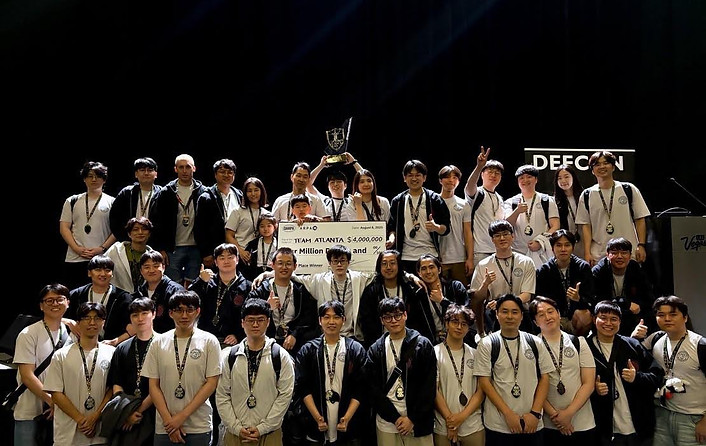
Join our SVCC 2026 tutorial to uncover real attack vectors, defense strategies, and hands-on insights led by the first-place team from Georgia Institute of Technology at DARPA’s AI Cyber Challenge (AIxCC). Here is news coverage of the winning team from Atlanta.
Tutorial for Bug-Finding and Patching for the LLM Era
When: June 12, 2026 from 10 a.m. to 4 p.m., excluding lunchtime.
Tutorial Leader: Dr. Taesoo Kim, Professor, Georgia Institute of Technology
Speakers: Andrew Chin (Ph.D) and Brian Lee (Ph.D)
Short Bio: Andrew and Brian are are Ph.D. students in the Systems Software and Security Lab at the Georgia Institute of Technology, advised by Prof. Taesoo Kim. Andrew is a core member of Team Atlanta, a multi-organizational collaboration that took first place in the DARPA AI Cyber Challenge (AIxCC). Building on the work from AIxCC, Andrew is leading a Team Atlanta effort — in partnership with the Open Source Security Foundation (OpenSSF) — to give back to the community by developing a unified framework and standard to advance the future of Cyber Reasoning System development. Brian's goal is to develop efficient bug-finding frameworks and automated vulnerability management systems, particularly for the open-source community, ultimately contributing to global security as a whole.
Here is the detailed agenda. This tutorial provides lab components, including hands-on exercises and demos.
-
Introduction to OSS-CRS: Overview, Goals, and Features
-
Lab Environment Setup
-
Participants are expected to bring their own machines with Vagrant (https://developer.hashicorp.com/vagrant/install) installed. We will prepare and provide a Linux VM image.
-
-
Introduction to Fuzzing (Lab 1)
-
Have hands-on experience running a fuzzer and watching it produce a crash
-
Give participants a project (or group of projects) that contains a bug discoverable by fuzzing
-
Provide an explanation of the bug and its root cause, helping participants understand the issue
-
-
Security Patching: Demonstrate automated security patching (Lab 2)
-
Run a basic patching CRS and study the produced patch
-
Demonstrate that the patch fixes the security vulnerability found by the fuzzer
-
-
Limitations of Traditional Fuzzing (Lab 3)
-
Demonstrate the limitations of the basic fuzzer
-
Give participants another project (or group of projects) that contains bugs that are hard to find via fuzzing
-
-
Lunch Break
-
CRS: Creating/Enhancing a CRS (Lab 4)
-
Provide hands-on experience with CRS development
-
Emphasize the functions and components in CRS that help overcome the limits of fuzzers
-
-
Prompt engineering for an existing agentic CRS (Lab 4.1)
-
Overriding the compiler pass for bug finding (Lab 4.2)
-
Using static analysis to enhance agents (Lab 4.3)
-
Including additional tools that agents can utilize for deeper analysis (Lab 4.4)
-
Enhancing results through collaboration among agents (Lab 4.5)
-
Introduce diverse techniques
-
Closing: Ensembling CRSs & Remarks
-
Demonstrate how combining all of them leads to more effective bug finding and patching
-
Run the basic CRSs with different models
-
Wrap up the session
-